Overview
When MentoraX came to us, they weren't asking for a marketing campaign. They were asking a harder question: how do you market a category that doesn't exist yet, across five sub-brands, without sounding like five separate companies?
We answered with a single, integrated demand architecture, one parent brand framework, four entity playbooks, two industry verticals, and a marketing prioritization model that told them where every dollar should go for the next five years.
The Challenge
MentoraX is an AI-native capability enablement company, the kind of business the market doesn't have a clean label for yet. They sit deliberately outside three crowded categories: online education, AI consulting, and SaaS tooling. Their thesis is sharp: AI doesn't create a durable advantage on its own; structured capability does.
But that thesis came with a marketing problem.
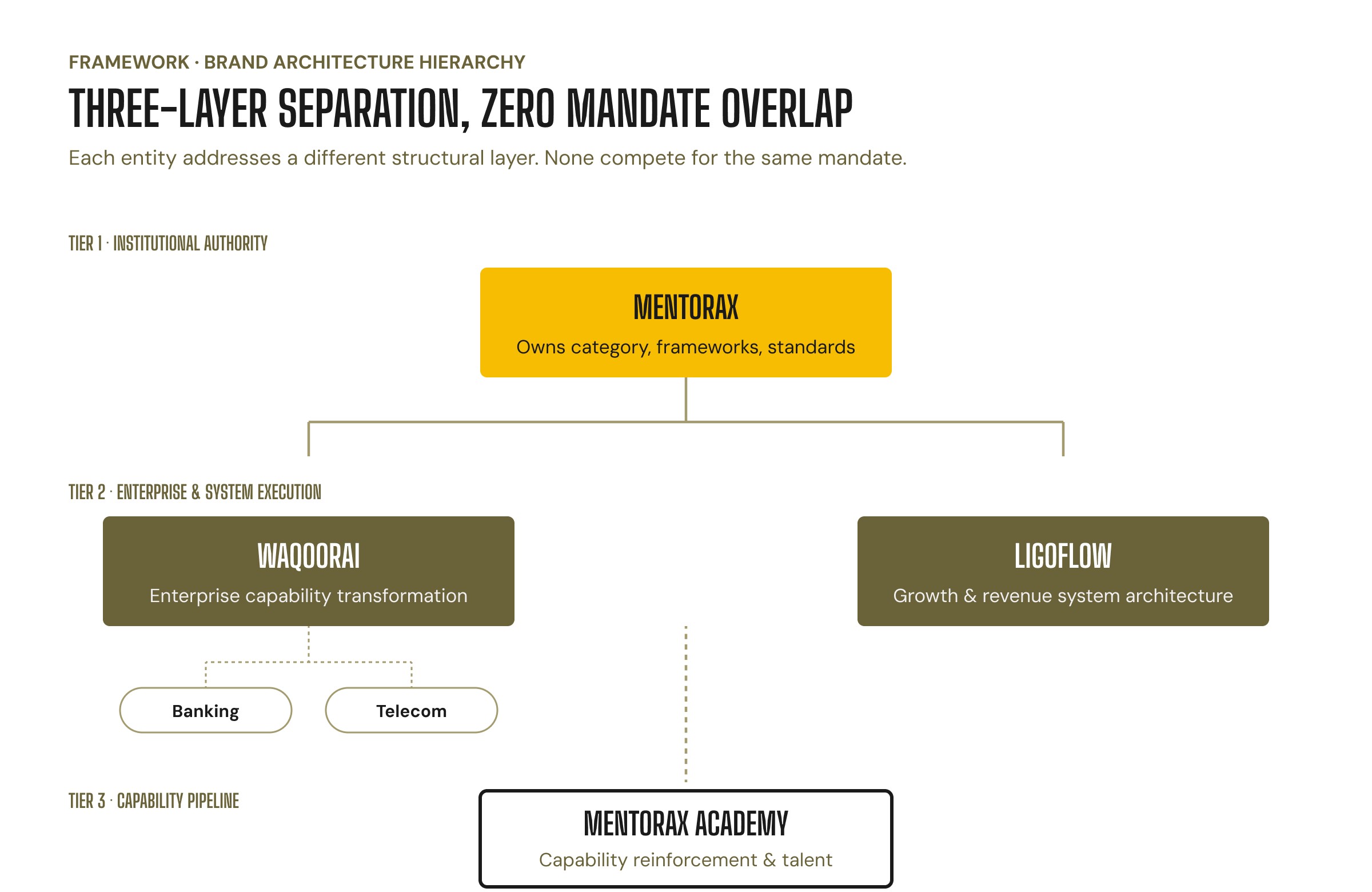
Their ecosystem includes one parent brand (MentoraX), two enterprise execution arms (WaqoorAI for transformation, Ligoflow for growth systems), and a capability layer (MentoraX Academy). Each one has a different ICP, a different buying cycle, and a different revenue density. Two of those entities, WaqoorAI Banking & Telecom, needed deeper vertical playbooks because regulated industries don't buy AI the way SaaS companies do.
A standard GTM strategy doesn't survive that kind of complexity. We've seen the typical agency response: produce one positioning deck and reuse it everywhere. The result is brand fragmentation, five entities competing for the same air, none of them defensible.
MentoraX needed something different.
The Approach: Demand Architecture, Not a Marketing Plan
Most marketing playbooks start at the channel layer, such as what to post on LinkedIn, what ads to run, and what email cadence to use. We don't start there. We start with the architecture buyers actually move through.
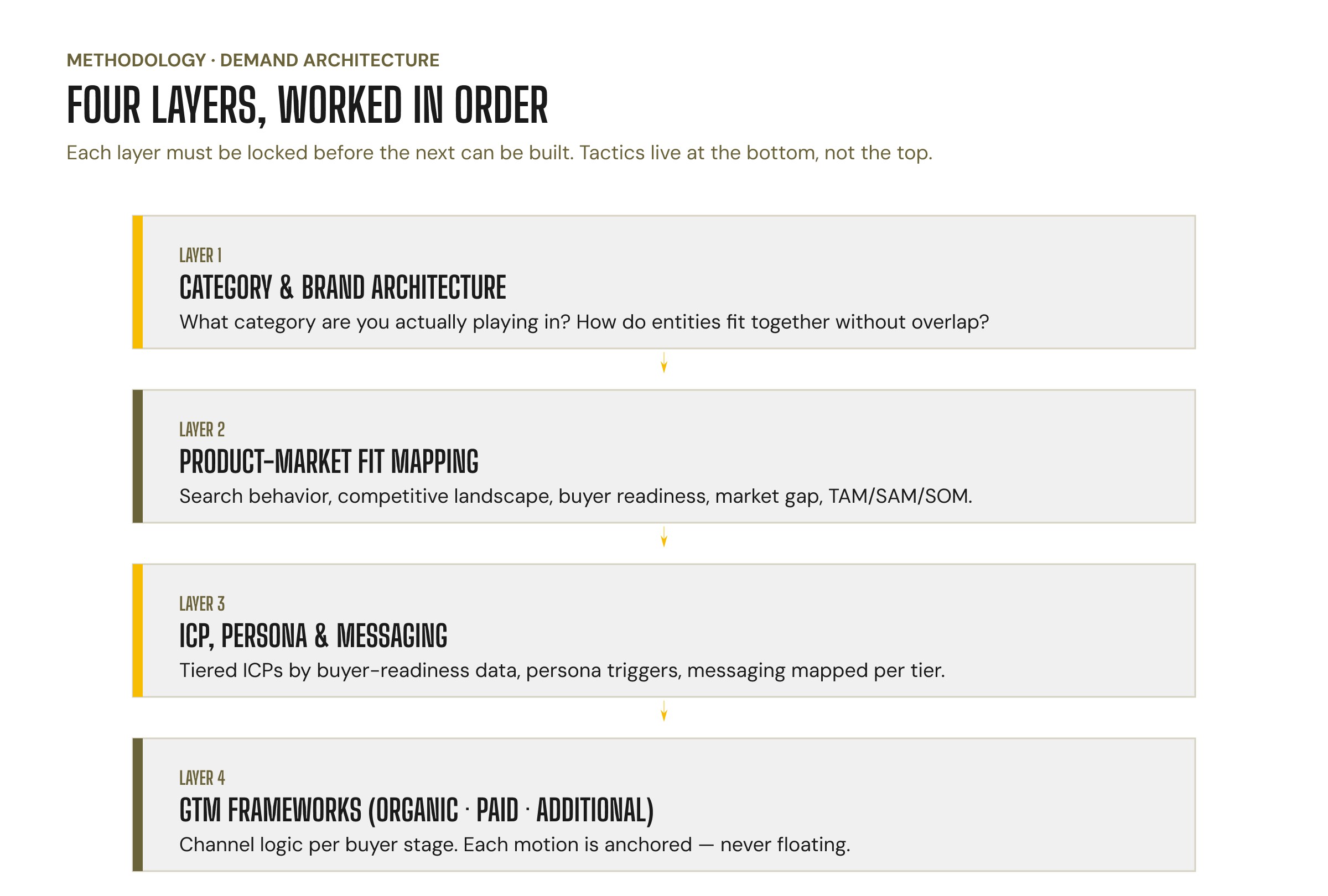
Our methodology has four layers, and we worked on them in order:
Layer 1 — Category & Brand Architecture. Before any tactic, we define what category the company is actually playing in, why that category is structurally defensible, and how the brand portfolio fits together without overlap. For MentoraX, this meant formalizing AI-Native Capability Enablement as a category and locking in a three-layer brand hierarchy.
Layer 2 — Product-Market Fit Mapping. For each entity, we map where demand actually lives. That means search behavior analysis, competitive landscape mapping, buyer readiness scoring, and explicit identification of the market gap each entity is filling. This is where TAM/SAM/SOM gets earned, not assumed.
Layer 3 — ICP, Persona & Messaging. Every entity gets a prioritized ICP layer (primary, secondary, separate motion), persona-level buying triggers, and a messaging framework mapped to each ICP. No "we serve everyone" statements. We tier ICPs by buyer readiness data, not by preference.
Layer 4 — GTM Frameworks. For each entity, we build three GTM motions: an organic framework (LinkedIn, long-form content, founder distribution), a paid framework (channel logic, intent targeting), and an additional marketing effort layer (events, partnerships, PR). Each one is tied to a specific buyer stage, so the work compounds instead of cannibalizing.
The principle behind all four layers: prioritize high-intent traffic over high-volume traffic, and quality over reach. In B2B demand generation, the quietest channel that hits the right buyer at the right stage outperforms the loudest one that hits the wrong stage every time.
Inside the Engagement
The final deliverable was a 177-page playbook. Here's what's in it.
Phase 1 — Strategic Positioning Paper (MentoraX Parent Brand)
We opened with the institutional spine, the document the rest of the ecosystem hangs from.
This paper defined the category (AI-Native Capability Enablement), differentiated it from four adjacent categories that buyers might confuse it with, and locked in a five-year strategic ambition tied to measurable outcomes, framework standardization, professional credentialing, enterprise integration, ecosystem coherence, and institutional recognition.
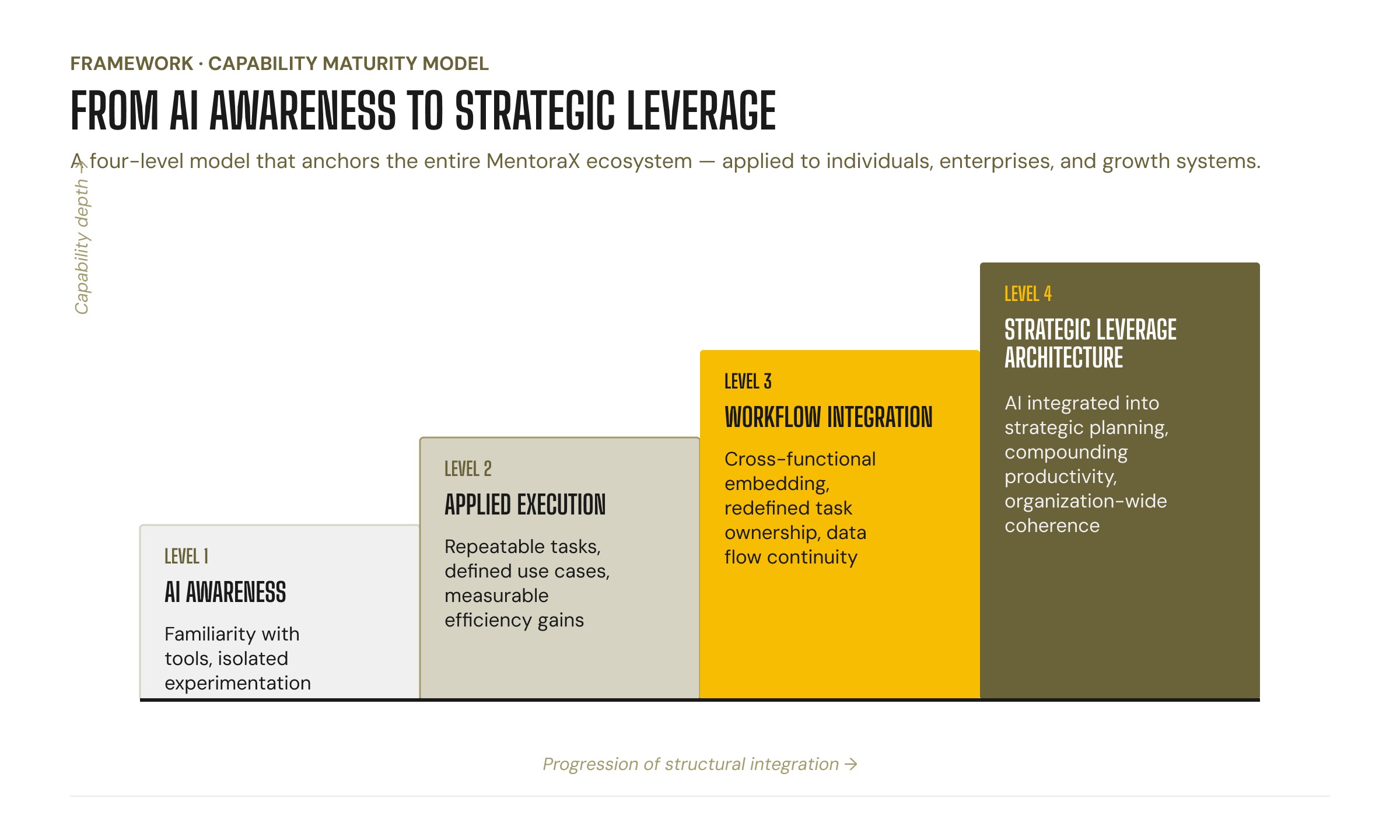
Most importantly, it produced the Capability Maturity Model, a four-level framework (Awareness → Applied Execution → Workflow Integration → Strategic Leverage) that became the intellectual backbone across every other entity. One framework, one shared vocabulary, no brand fragmentation.
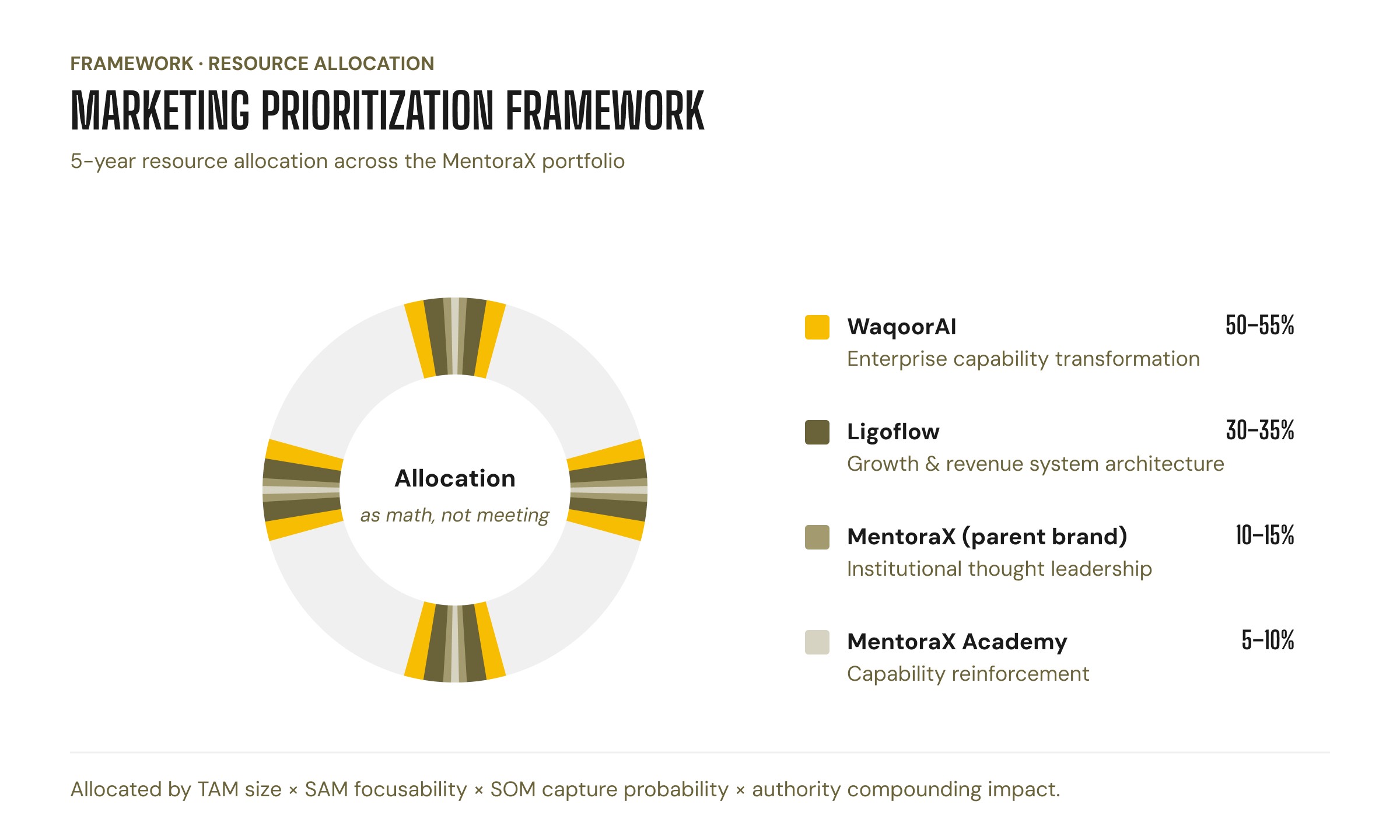
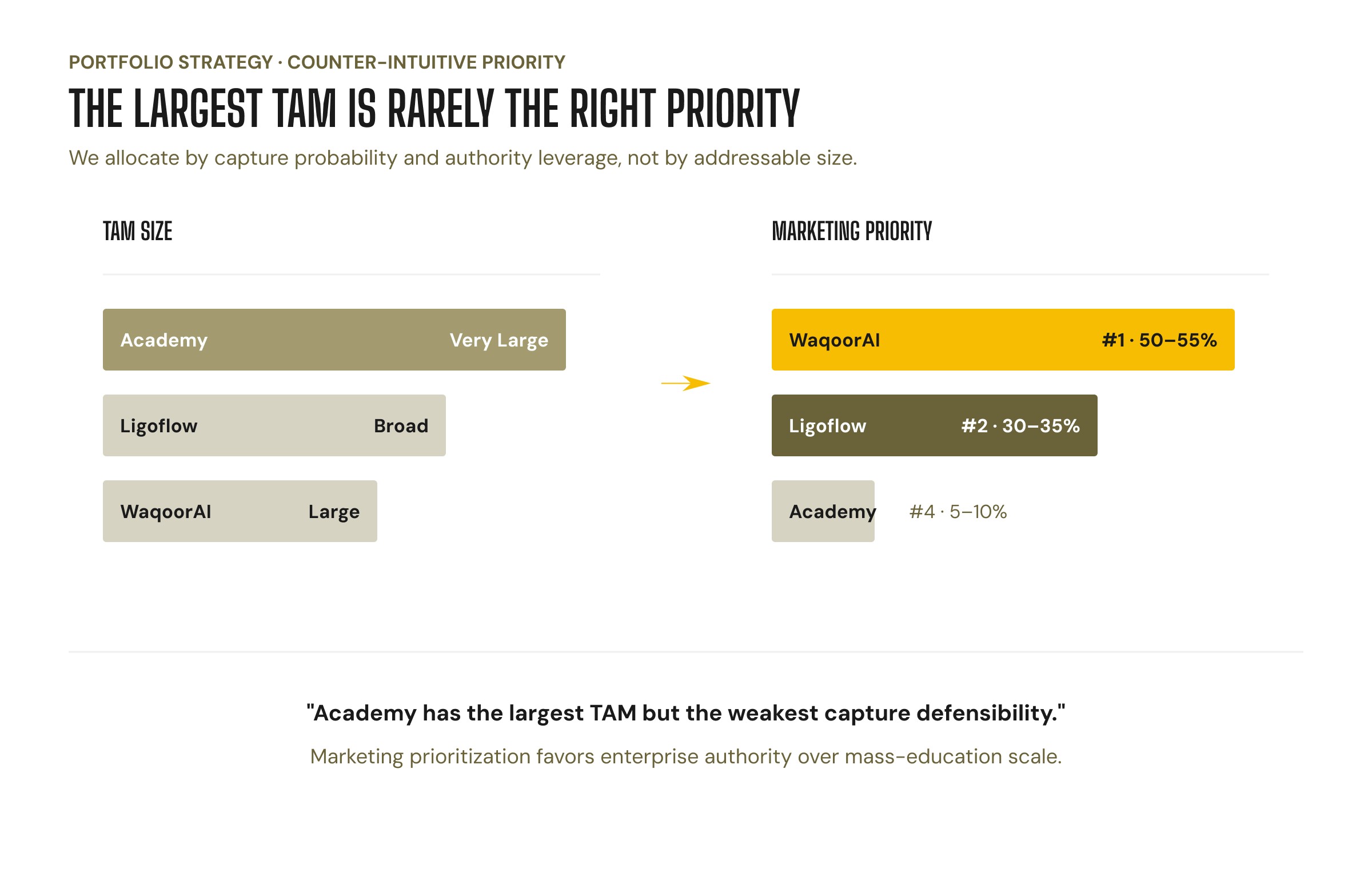
We also delivered a Marketing Prioritization Framework that allocated resources across the portfolio based on TAM size, SAM focusability, SOM capture probability, and authority compounding impact. The output: 50-55% to WaqoorAI, 30-35% to Ligoflow, 10-15% to parent brand thought leadership, 5-10% to Academy. Resource allocation became a math problem, not a meeting.
Phase 2 — Ligoflow (Growth System Architecture)
Ligoflow was the first execution layer to land. The deliverables covered:
Market Insight & Buyer Stage analysis. Search behavior data showing the Conversation Intelligence category sits in a learning-market posture, not a buying-market one. Strategic implication: education > differentiation at this stage.
Competitive landscape & PMF signals. Where Ligoflow fits in a fragmented category dominated by analytics tools that explain conversations but don't drive execution.
Gulf Region TAM/SAM/SOM model. Conservative estimate of $5–7B TAM led by BPO and SaaS, with segment-by-segment readiness scoring, Customer Support Ops at 20-30% buyer readiness, Sales at 10-15%, Ops at 5-10%, Freelancers under 5%.
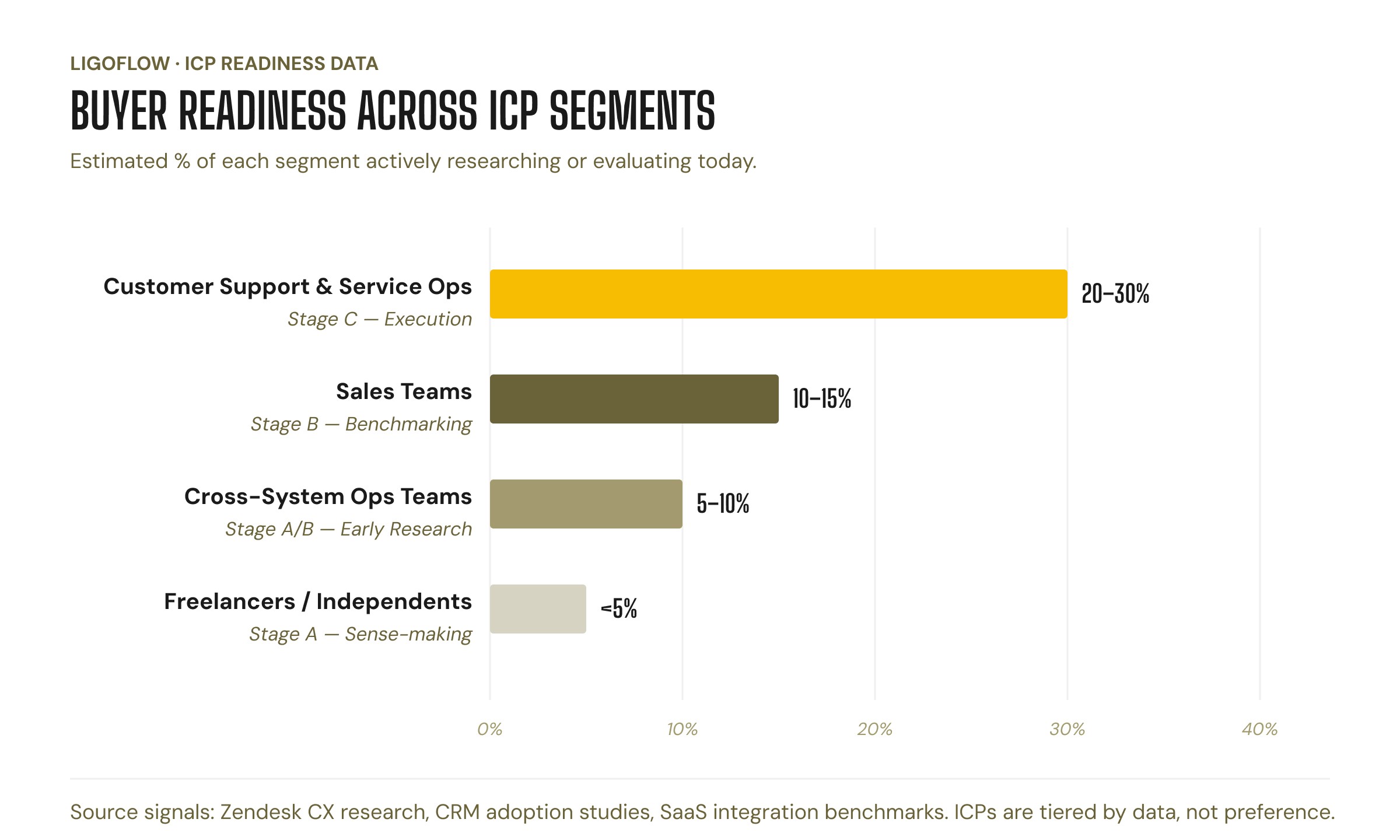
ICP layers, prioritized. Customer Support & Service Operations as primary; Sales and Cross-System Ops Teams as secondary; Freelancers as a separate motion entirely (different pricing, different message, different funnel).
Persona profiles & messaging framework mapped to each ICP.
Five-stage buyer journey (Unaware → Problem Aware → Solution Aware → Vendor Aware → Ready to Buy), with Ligoflow's marketing role defined for each stage.
Organic, paid, and additional GTM frameworks, including LinkedIn-first content motion, blog/long-form supporting layer, and founder-as-distribution playbook.
Phase 3 — WaqoorAI (Enterprise Capability Transformation)
WaqoorAI is the highest-revenue-density entity in the portfolio, so it received the most marketing weight. The general WaqoorAI playbook covered the same nine-module structure as Ligoflow, but with enterprise-grade adjustments, longer sales cycles, governance-first messaging, executive roundtables instead of demand-gen funnels, and capability maturity diagnostics as a primary entry asset.
Phase 4 — Vertical Extensions: Banking & Telecom
This is where the work got specific. We built two full vertical playbooks because regulated industries don't behave like horizontal SaaS markets.
WaqoorAI Banking & Finance. Built around the insight that Banking AI demand isn't blocked by skepticism, it's blocked by deployability. We positioned WaqoorAI as an AI infrastructure extension, not a replacement layer, with a messaging framework anchored in data sovereignty, auditability, and on-premise/hybrid architecture. The entire GTM is calibrated for risk-sensitive enterprise buyers who prioritize control over convenience.
WaqoorAI Telecom. Sized for large-scale operational AI integration in data-intensive environments, with a buyer journey designed around system-wide automation coordination rather than departmental tooling.
Phase 5 — MentoraX Academy
The Academy is a deliberate counter-positioning move. Despite having the largest TAM in the portfolio (global professionals seeking AI upskilling), it's the lowest marketing priority, because in saturated mass-education markets, scaling without dilution is harder than scaling an enterprise.
The playbook positions Academy as a capability reinforcement infrastructure rather than a standalone education brand: invite-based cohorts, enterprise-embedded programs, and alumni amplification. Low volume. High credibility.
Frameworks We Built (And Why They're the Real Asset)
A 177-page document is not the deliverable. The frameworks inside it are.
The Capability Maturity Model
Four levels: AI Awareness, Applied Execution, Workflow Integration, and Strategic Leverage. Applies to individuals (Academy), to enterprise transformation (WaqoorAI), and to growth systems (Ligoflow). One model, three different commercial applications, zero positioning conflict.
The Five-Stage Buyer Journey
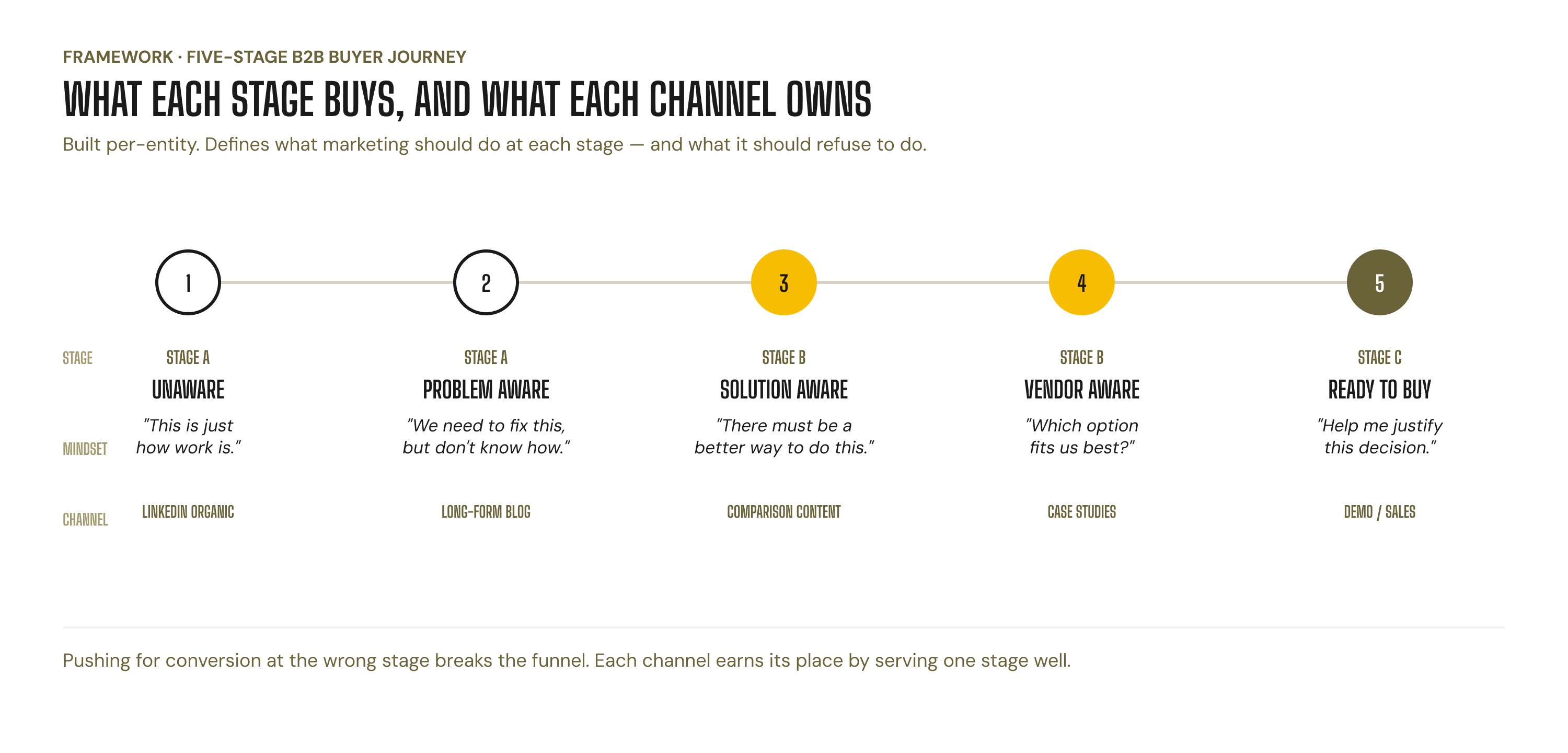
Unaware → Problem Aware → Solution Aware → Vendor Aware → Ready to Buy. We built this for every entity. The model defines what each marketing channel should do at each stage, and crucially, what it should refuse to do. Organic content at the Unaware stage, for example, is not a lead capture channel. Pushing for conversion there breaks the funnel.
The Marketing Prioritization Framework
A four-variable allocation model: TAM size × SAM focusability × SOM capture probability × authority compounding impact. The output is a defensible budget split that survives executive review. No, "we should spend more on X because it feels strategic", every allocation is justified.
The Brand Architecture Hierarchy
Three layers, clean separation: institutional authority (parent brand), enterprise execution (commercial entities), capability infrastructure (Academy). Structural guardrails prevent vertical expansion or commercial pressure from corrupting the framework.
These frameworks aren't decorations. They're the reason the playbook compounds, because the same intellectual model holds across every entity, the marketing team can scale execution without re-deciding strategy every quarter.
What the Engagement Produced
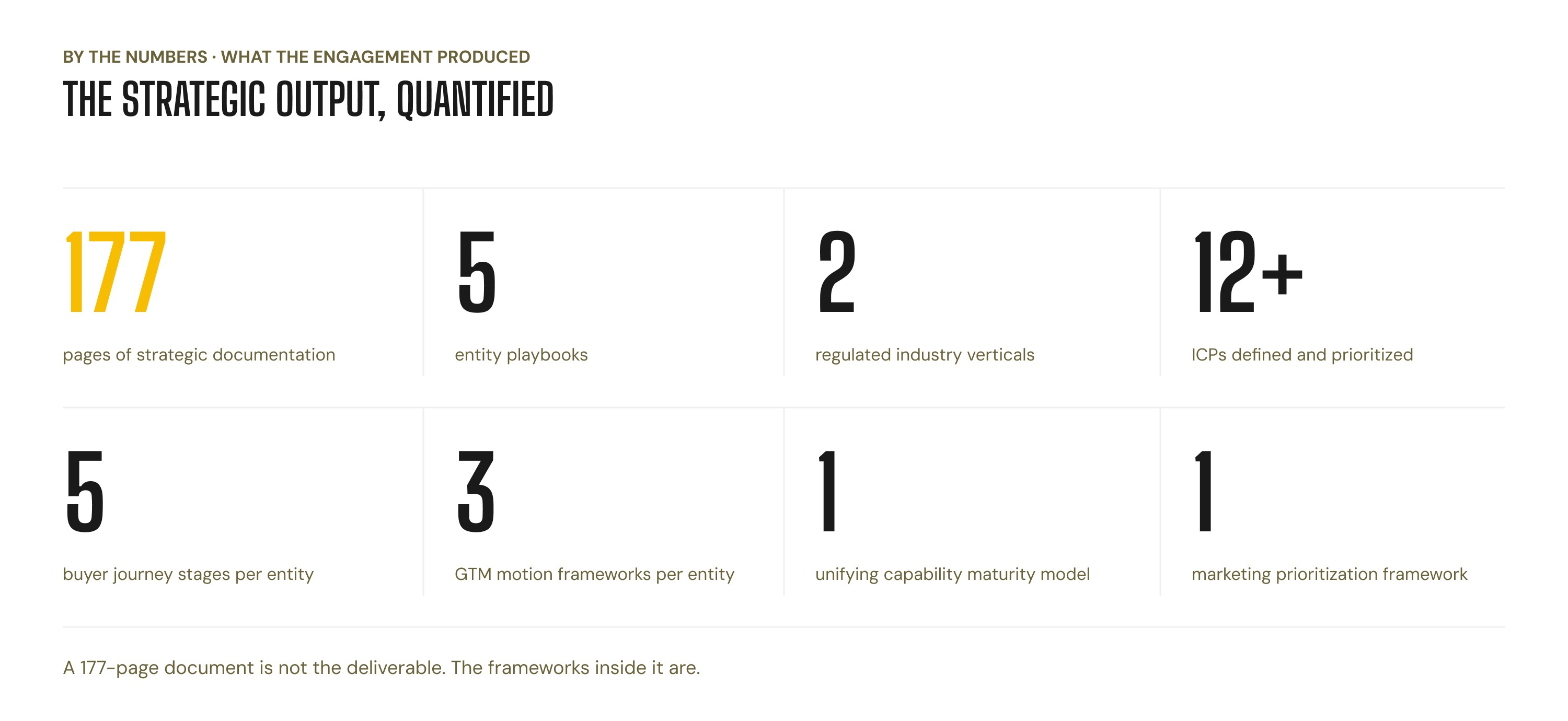
By the numbers:
177 pages of strategic documentation
5 entity playbooks (MentoraX parent brand, Ligoflow, WaqoorAI general, WaqoorAI Banking, WaqoorAI Telecom, MentoraX Academy)
2 industry verticals with bespoke positioning, ICP, and GTM frameworks
12+ ICPs defined, prioritized, and mapped to messaging
5-stage buyer journey modeled per entity, with stage-specific channel logic
3 GTM motion frameworks per entity (organic, paid, additional)
1 unifying Capability Maturity Model spanning the entire ecosystem
1 Marketing Prioritization Framework with explicit resource allocation %
What MentoraX Walked Away With
The deliverable was a document. The outcome was something else.
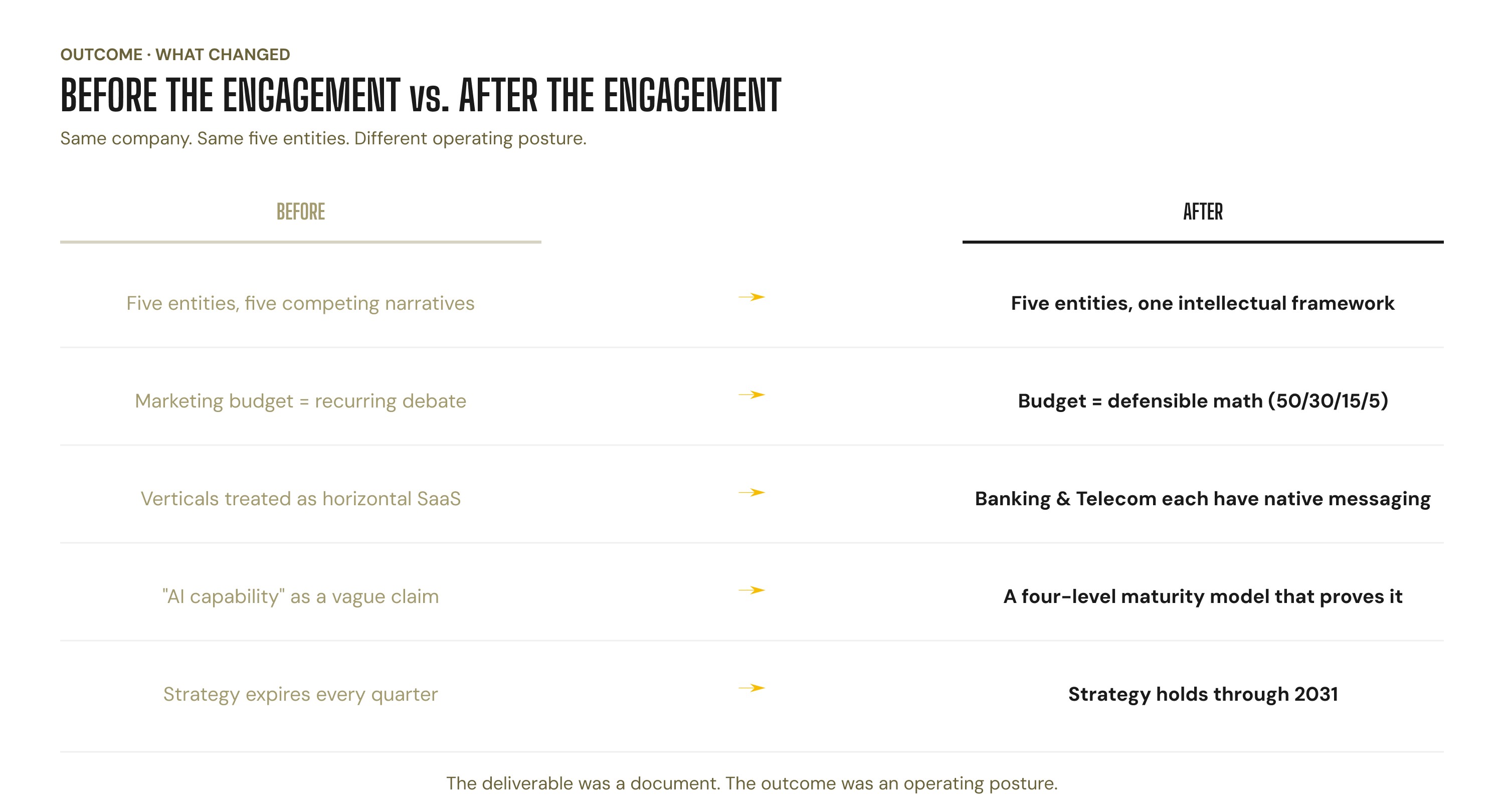
Resource clarity. Before this engagement, marketing budget was a discussion. After, it was math: 50-55% to WaqoorAI, 30-35% to Ligoflow, the rest to parent brand and Academy in defined ratios. Internal alignment moved from debate to execution.
Vertical-ready GTM. Banking and Telecom don't share a sales motion with horizontal SaaS, and now the playbooks reflect that. Each vertical can be activated independently without re-strategizing.
Defensible category positioning. AI-Native Capability Enablement is now a defined category with a defined maturity model. When competitors enter, they enter on MentoraX's structural ground, not the other way around.
Brand portfolio coherence. Five entities, one intellectual framework, zero overlap. The Capability Maturity Model functions as the intellectual backbone that prevents brand fragmentation as the company scales.
Five-year clarity. The playbook isn't a one-quarter artifact. It's the operating system MentoraX will run through 2031.
When This Kind of Work Makes Sense
We don't build 177-page playbooks for every client. Most don't need it. This depth of demand architecture is the right answer when:
You're creating or operating in a category that doesn't have established market language yet
Your business has multiple entities, products, or verticals that risk competing for the same buyer attention
Your sales cycle is long enough that messaging consistency across the funnel materially affects close rate
You're entering regulated or specialized verticals where horizontal positioning will fail
You're at the stage where unfunded marketing decisions cost more than the strategic engagement itself
If you're earlier than that, pre-PMF, single product, single ICP, this is overkill. We'll tell you so.
Frequently Asked Questions
How long did this engagement take? Engagements at this depth typically run 8–14 weeks, depending on the number of entities and verticals. MentoraX involved five entities and two regulated verticals, which sat at the upper end of the range.
What's the difference between a "marketing playbook" and a GTM strategy? A marketing playbook tells you what to post, send, and ship. A GTM strategy tells you which buyer to target, why your category exists, and how your sales motion compounds. We deliver both, but the playbook only works if the strategy underneath it is right.
Who is the right client for this kind of engagement? Mid-stage to growth-stage B2B companies with multiple products, sub-brands, or industry verticals, particularly in AI, enterprise software, and regulated industries. Marketing leaders, sales leaders, and B2B founders are usually the buyers.
Do you build the GTM strategy or also execute it? Both. We typically build the architecture first, then engage on demand generation execution against it, content, paid, lifecycle, sales enablement, so the strategy doesn't sit in a deck.
How do you measure success on a strategic engagement like this? We measure on three layers: structural (does the framework hold up under live execution?), commercial (does pipeline quality improve against the redefined ICP?), and authority (does category leadership compound through earned media and inbound demand over 12–24 months?).
Lets Nara is a B2B demand and lead generation agency working with marketing leaders, sales leaders, and B2B founders to build defensible category positioning and pipeline-grade demand engines.